
Port Power

Depot

Family Laundry: The World’s Most Advanced Managed EV Depot

In a industrial corner of Oakland, California, Family Laundry faced a challenge: how to transition to electric vehicles without disrupting daily operations. Their solution, powered by Port Power’s intelligent infrastructure, isn’t just another charging station—it’s a complete fleet operations platform that happens to also optimize energy costs.
Fleet Operations Come First

For Family Laundry, a commercial laundry service running daily delivery routes across Oakland, the question wasn’t whether EVs could save money. The math was clear: approximately $10,000 per vehicle per year in savings, even without government incentives. The real challenge was operational: how do you ensure every vehicle is charged and ready for its route without adding complexity, manual coordination, or operational risk?

Traditional charging infrastructure treats this as a hardware problem—install enough chargers, hope for the best. Port Power approached it as a fleet management problem that requires deep integration with how the business actually operates.

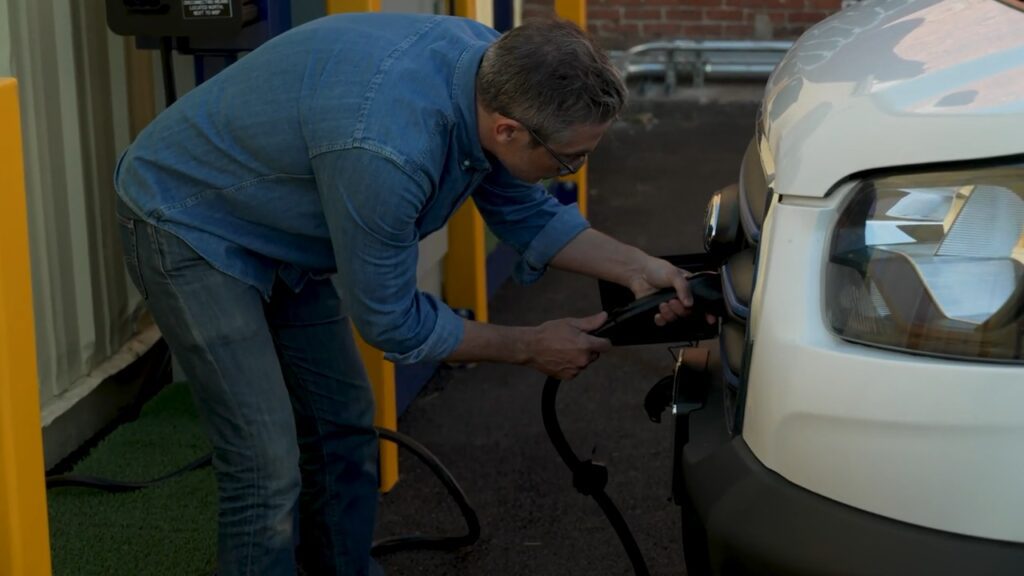
The system integrates directly with Family Laundry’s vehicle telematics, pulling real-time data on each vehicle’s state of charge, location, and usage patterns. When a driver returns from their route and plugs in, the Port Cloud platform immediately knows which vehicle it is, how much charge it has, and—critically—when it needs to leave for its next route the following morning.

This isn’t just monitoring; it’s predictive optimization. Each vehicle gets precisely the charging it needs, prioritized based on departure time and mission requirements, without anyone manually programming schedules or moving vehicles around. The result? Drivers park their vehicles and walk away. Everything else happens automatically. No shuffling vans at 2 AM. No morning surprises finding vehicles that didn’t charge. No complex scheduling spreadsheets. The fleet is just ready, every morning, exactly as needed.

From Cost Center to Profit Center

But Family Laundry discovered something even more valuable: their charging infrastructure could generate revenue.

The depot hosts multiple separate fleets, each with different vehicles, schedules, and operational requirements. This multi-tenant capability transforms the entire economic model of depot infrastructure. What was previously a capital expense that only benefited their own fleet now generates revenue from hosted tenants.

The genius of Port Power’s system is that multi-fleet operations require no additional operational overhead. License plate recognition (LPR) cameras automatically identify each vehicle as it arrives, instantly linking it to the correct fleet account. Access control happens invisibly—no cards, no apps, no check-in process. A driver from a tenant fleet simply plugs in, and the system handles everything else.

For the hosted fleets, this solves a massive problem. Small to medium-sized fleets often can’t justify building their own depot infrastructure—the capital costs, permitting complexity, and technical expertise required create insurmountable barriers. By hosting them, Family Laundry provides instant access to enterprise-grade charging infrastructure.

But managing multiple fleets with different needs and priorities could be operationally complex. This is where Port Power’s intelligent prioritization becomes crucial. The system understands that Family Laundry’s own vehicles get top priority—they’re the reason the depot exists. Tenant fleets receive charging based on their service tier agreements, available capacity, and their own departure schedules.

Behind the scenes, the Port Cloud platform tracks every charging session, categorized by fleet, vehicle, and time. Family Laundry receives detailed utilization reports showing exactly which vehicles charged when, for how long, and how much energy they consumed. This granular data enables accurate billing to tenant fleets while providing analytics about usage patterns that inform capacity planning.

Multi-Fleet Complexity Made Simple

Managing three separate fleets at one facility would typically require separate infrastructure, complex access controls, and significant manual coordination. Port Power’s approach makes it feel effortless.

When a vehicle plugs in, it might receive full power. When another arrives that needs to leave in 4 hours, the system might allocate more power to ensure it reaches the required charge level in time If power capacity is constrained, at the expense of vehicles that have more time to charge, or are lower priority.

This dynamic prioritization happens continuously, reassessing hundreds of times per night as vehicles plug in, reach target charge levels, or need boosted priority due to schedule changes. The system balances fairness to tenant fleets with priority for the host fleet, while ensuring every vehicle reaches its required charge level before departure.

The LPR system provides an additional operational benefit: parking enforcement. The cameras can detect when non-EV vehicles occupy charging spaces, when vehicles remain plugged in after charging completes, or when unauthorized vehicles attempt to use the facility. This automated enforcement ensures the infrastructure remains available for its intended purpose without requiring manual oversight.

For Family Laundry, this hosting capability has created a new revenue stream that substantially improves the return on their infrastructure investment. For the tenant fleets, they gain access to reliable, professionally managed charging infrastructure that would have been impossible to build independently. It’s a genuinely win-win arrangement enabled by intelligent software.

Energy Optimization: The Secondary Benefit

With fleet operations optimized, Port Power’s system turns to minimizing energy costs—and this is where the microgrid capabilities come into play.

The facility features a 50 kW solar array and 233 kWh battery energy storage system (BESS) working in concert with the charging infrastructure. During the day, solar panels generate power that charges the battery. At night, that stored energy powers vehicle charging, supplemented by grid electricity only as needed.

But it’s more sophisticated than simple solar-plus-storage. The system performs real-time grid arbitrage, buying electricity when rates are low and discharging the battery during expensive peak periods. It shaves demand peaks that would trigger high utility charges. It coordinates solar generation, battery dispatch, building loads, and vehicle charging to minimize total energy costs across the entire facility.

This energy optimization happens as a background process, never interfering with fleet priorities. If vehicles need charging during an expensive rate period, they get charged—but the system draws from the battery first, minimizes grid usage, and staggers loads to avoid demand charges wherever possible.

The result is an 80% reduction in energy costs compared to unmanaged charging. For a depot supporting multiple fleets with dozens of vehicles, that’s many thousands of dollars per month in savings. These savings flow back to Family Laundry’s bottom line.

Built to Scale

The depot’s modular architecture using standardized PortSkids and PortPanels means expansion is straightforward. As Family Laundry adds more vehicles or takes on additional tenant fleets, they can add charging capacity or reconfigure the parking lots’ modular units—no redesign, no custom engineering.

The facility was implemented in two phases: first the charging infrastructure to get operations running, then the solar and storage systems to optimize energy costs. This phased approach allowed the fleet to start benefiting immediately while building toward the complete solution.

A New Model for Fleet Electrification

What makes the Family Laundry depot the world’s most advanced isn’t the hardware—it’s how the system prioritizes fleet operations above everything else. The technology exists to serve the business needs, not the other way around.

Fleets need reliable operations, not science projects. They need vehicles ready on time, every time. They need systems that work invisibly in the background. And increasingly, they need ways to offset infrastructure costs through shared utilization.

Port Power’s approach delivers all of this while also optimizing energy costs and enabling renewable integration. But those benefits come secondary to the primary mission: keeping fleets running smoothly.

As more urban delivery operations electrify, the Family Laundry model offers a template that works: fleet operations first, energy optimization second, and shared infrastructure to improve economics for everyone. That’s the future of managed depots, and it’s already operating in Oakland.
Family Laundry Press Conference Depot

City of Oakland Announces Port Power’s Family Laundry EV…

EV Charging System Provides Business Savings and Community Benefits

Published on November 07, 2025

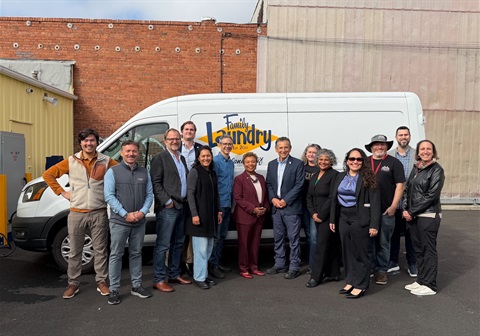
Family Laundry Press Conference

Oakland, CA – Today, Oakland officials announced that Family Laundry, a family-owned business established in 2018 and one of the Bay Area’s leading wash-and-fold laundry pickup and delivery services, installed solar, batteries, and integrated electric vehicle (EV) charging infrastructure at their facility in Oakland’s San Antonio neighborhood. The site now has capacity for 17 electric vans to be charged using solar power.  

Partners supporting this $1M project included regional agencies Bay Area Air District and PG&E; community development finance organization Pacific Community Ventures; the LA Cleantech Incubator; and innovative technology provider Port Power. The chargers will be shared with Community Kitchens, which acquired an all-electric, refrigerated delivery van. 

This project advances the City of Oakland’s Equitable Climate Action Plan (ECAP) and Zero Emission Vehicle (ZEV) Action Plan, which place local businesses, health, and environmental justice at the forefront of climate action.  

City staff recruited Los Angeles Cleantech Incubator (LACI) to fund an extension of the project to Community Kitchens, an Oakland nonprofit tackling food insecurity. Community Kitchens will have access to chargers for their delivery vans, reducing their operational costs and improving reliability. The organization provides food to unhoused residents, healthy snacks and meals for OUSD and serves low-income youth, families, and seniors in neighborhoods where over half the people go to bed hungry. Community Kitchens vans drive all over the city to harness the power of food to change lives, uplift communities and protect the environment. Family Laundry’s “community access charger” used by Community Kitchens will remain a climate asset for Oakland’s San Antonio neighborhood. 

“This project represents the kind of innovative partnership Oakland needs to meet our climate goals. I want to thank Family Laundry and Port Power for making it a reality, particularly the decision to extend charging access to Community Kitchens. That choice demonstrates what Oakland is fundamentally about: ensuring that those most in need of investment are included in our climate transition. By reducing operational costs for organizations serving our most vulnerable residents, we enable them to expand the essential work our community depends on. This project proves that when Oakland’s businesses, nonprofits, and public agencies work together, a just transition to a green and equitable economy isn’t merely aspirational- it’s within reach,” said Oakland Mayor Barbara Lee.  

Investments in solar, batteries, and EV charging can save businesses money in the long term, helping them to thrive & stay rooted in Oakland. Family Laundry knew that switching from fossil fuels to clean, reliable electricity was the next step to keep their business thriving. They chose Port Power’s modular “Depot in a Box” that combines charging hardware, energy management software, and site automation into pre-integrated packages that can be deployed rapidly on an existing site. The Depot in a Box will support 17 charging ports with solar and battery storage—all built on modular infrastructure. The platform incorporates microgrid capabilities, enabling daytime solar collection to charge Family Laundry’s delivery vans overnight. Assets like these protect businesses from increasing energy and gas costs and ensure access to more reliable EVs. 

“Oakland’s landmark Equitable Climate Action Plan put us on a path to climate neutrality by 2045, eliminating fossil fuels in buildings by 2040, and leading with justice. The recently-adopted Economic Development Action Plan provides the roadmap to strengthen Oakland businesses and invest in climate-positive work that serves our community. Lasting climate and justice work can only happen with community and business leadership – and for that to happen robustly, we need investment and support. I want to thank the investors and funders who enabled this project, as well as Family Laundry, Community Kitchens, and Port Power for their vision, focus on the community, and commitment to equitable climate action,” said Shayna Hirshfield-Gold, Oakland’s Acting Sustainability Director.  

Business solutions like these address the economic and operational challenges that have historically made EV fleets accessible only to large companies. Port Power’s system enables any delivery fleet to go electric without the utility service upgrades that often add multi-year delays and extensive costs to fleet electrification. Family Laundry is not only expanding its capacity to serve more customers: they are setting an example for sustainable practices in the service industry. 

“It Only Makes Sense.” 

The new system has already helped Family Laundry expand operations while reducing their carbon footprint. Specifically, moving to electric delivery vans, powered by the sun, is helping them: 

  • reduce their ecological footprint by an estimated 8 metric tons of CO₂ annually per vehicle; 
  • save energy, with their cost per mile dropping from 40 cents per mile before electrifying, to 25 cents per mile with EVs on standard charging — soon to be 5 cents per mile with the new charging depot – an estimated annual savings of roughly $10,000 per vehicle! 
  • reduce operational costs, with thousands of dollars saved on maintenance per vehicle each year. 

Delivery businesses face a challenging landscape with increasing fuel costs. Combined global and local forces are expected to continue this trend into 2026. Cost reductions for businesses keeps goods and services moving, maintain jobs, and provide vital services to the public.  

Partnerships and Investment are Critical 

Collaborative investment made today’s project possible. Port Power provided technical assistance and design; critical grant funding came from the Bay Area Air District, LACI, and PG&E; and local finance organization, Pacific Community Ventures (PCV), made the largest investment from their Climate Resilience Fund. 

“PCV’s Climate Resilience Mobilization Fund envisions a future that centers the power and wealth-building potential of the climate economy within historically underestimated communities that have been denied access for too long. Our aim is to bridge the gap and empower small businesses to undertake projects they would otherwise be unable to pursue,” said Bulbul Gupta, CEO of PCV. Affordable, flexible loans are made available with the intent to position underserved small businesses to participate in the emerging climate economy, fostering job creation and wealth-building opportunities within diverse communities. 

Extending the Work 

City of Oakland Business License Application data finds 475 Medium Duty and Heavy Duty trucking fleets are registered Oakland businesses. Not included in this total are the many businesses, like Family Laundry, who own trucks and deliver their product as a core part of their operations. These fleets move furniture, haul equipment, and deliver thousands of commercial goods across healthcare, retail, food, construction, and other Oakland sites. Even with modern efficiency gains, diesel engines remain a major source of pollution in Oakland neighborhoods, contribute to climate-change, and require more ongoing maintenance than EVs. As fuel costs rise, a focus on sustainably electrifying delivery vans makes sense for business and the environment.  

Projects like these position Oakland as a regional leader in the climate economy and show that everyone has a role to play in a just climate transition.  

What they’re saying:  

As Family Laundry co-owner David Macquart-Moulin says, “Going electric it makes financial sense, otherwise we wouldn’t do it. We are saving drastic amounts of a lot of money now, but a project of this size this really felt impossible when we started. We relied on a lot of partners to help guide us through. Family Laundry is not only expanding its capacity to serve more customers but is also setting an example for sustainable practices in the service industry.” 

Nadav Gur from Port Power is encouraging: “it’s that guidance that helps these projects pencil out. We can help these businesses afford the investment and save money.  Business solutions like these address the economic and operational challenges that have historically made EV fleets accessible only to large companies. Port Power’s system enables any delivery fleet to go electric without the utility service upgrades that often add multi-year delays and extensive costs to fleet electrification.” 

PARTNER PROFILES 

Family Laundry 

Family Laundry, a family-owned business established in 2018, has been serving the Oakland community. Operating from three locations in Oakland’s San Antonio and Fruitvale neighborhoods, the company employs more than 30 people, including delivery drivers and laundry technicians. They use free and clear detergents only, and eliminated bleach, dryer sheets, and plastic bags from their delivery business. Family Laundry has expanded its operations by transitioning to a fully-electric delivery fleet, significantly enhancing their delivery services while reducing their carbon footprint.   The business currently operates six electric delivery vans, with plans to expand the fleet to fifteen vans within the next three years.  

Port Power 

Port Power specializes in integrated EV charging infrastructure for small and medium-sized fleet operators. Building a modular, expandable end-to-end service that aims to provide fleets the solution they need at the growth rate they require, creating long-term infrastructure for businesses and communities.  

Community Kitchens 

Community Kitchens’ free and accessible meal program supports Oakland’s most vulnerable community members. Their mission is to bring our whole community together to harness the power of food to change lives, uplift communities and protect our environment. The guiding principle is that access to food and the dignity of a hot meal is a human right. Core priorities are filling in the gaps in existing food security systems, pioneering accessibility, and promoting dignity and connection. Being founded in Oakland, their programs are conscious of the diverse needs of our community and the historic institutionalized discrimination and racism that have led to dramatic inequalities in our community today. 

Pacific Community Ventures 

Pacific Community Ventures is a non-profit community investor that unlocks economic opportunity and climate resilience for small business owners and workers. Through access to affordable capital, pro bono business advising, ethical technology and AI, we partner with entrepreneurs to grow, hire, and prosper. PCV makes affordable, flexible loans available with the intent to position underserved small businesses to participate in the emerging climate economy, enabling job creation and wealth-building opportunities within diverse communities. Programs empower clients to play a significant role in climate action in the communities they call home while ensuring that climate economy jobs remain sustainable and resilient. PCV launched the climate Justice Mobilization Fund which includes new lending products paired with technical assistance tailored for small businesses working to accelerate the climate transition. 

Los Angeles Cleantech Incubator  

Founded in 2011 as an outcome of a public-private partnership with the City of Los Angeles and its Department of Water & Power (LADWP), the Los Angeles Cleantech Incubator (LACI), is focused on clean energy, zero emissions transportation, and sustainable cities. Our mission is to create an inclusive green economy by unlocking innovation, transforming markets, and enhancing communities. LACI aims to build a regional innovation ecosystem that supports the discovery and commercialization of clean technologies by creating new companies, derisking the go-to-market process, and helping companies successfully deliver market-ready cleantech solutions along with accompanying jobs in Southern California and beyond.  

Bay Area Air District 

In January 2025, the Bay Area Air District awarded Family Laundry a grant to install two DC fast charging ports and 15 Level 2 ports with supporting infrastructure. The California Legislature created the Air District in 1955 as the first regional air pollution control agency in the country.  The Air District is tasked with regulating stationary sources of air pollution in the nine counties that surround San Francisco Bay: Alameda, Contra Costa, Marin, Napa, San Francisco, San Mateo, Santa Clara, southwestern Solano, and southern Sonoma counties.  It is governed by a 24-member Board of Directors composed of locally elected officials from each of the nine Bay Area counties, with the number of board members from each county being proportionate to its population. 

PG&E 

Pacific Gas and Electric Company, incorporated in California in 1905, is one of the largest utility companies in the United States. Based in Oakland, the company is part of PG&E Corporation

Originally published by the City of Oakland at: https://www.oaklandca.gov/News-Releases/EV-Charging-System-Provides-Business-Savings-and-Community-Benefits

Hertz Pilot Discussion on YouTube Depot

Workplace Charging Facts: Announcing Results from our pilot with…

Look at all the cars parked at your office or warehouse parking lot. Now imagine 20, 50, 100% of them are electric. And imagine that it’s your job to make sure they are charged. This is not sci-fi, it is already the reality in several states and counties and almost inevitably in most of them within ten years.

When you need dozens or hundreds of chargers in your parking lot – how do you get power for all of them? How do you get enough energy? How do you balance your resources so you can get the infrastructure and the energy cost-effectively? Most importantly – how do you do it such that no driver gets stuck, and no one has to waste time at public charging or getting out in the middle of the day to move cars on / off the chargers?

This was the subject of the pilot and study we ran with Hertz Israel’s leasing business this year, which has now concluded successfully. We built a microgrid-enabled, scalable managed charging facility that integrated grid and solar electricity and ran it with drivers for four months. We collected data about driver and charging behavior, ranges and issues, power and energy output, infrastructure and energy costs and optimized the system for different scenarios.

We will be posting some of the learnings here, but if you want to learn more – contact us to discuss best practices for fleet / workplace charging.