
Port Power

Depot

Family Laundry: The World’s Most Advanced Managed EV Depot

In a industrial corner of Oakland, California, Family Laundry faced a challenge: how to transition to electric vehicles without disrupting daily operations. Their solution, powered by Port Power’s intelligent infrastructure, isn’t just another charging station—it’s a complete fleet operations platform that happens to also optimize energy costs.

Fleet Operations Come First

For Family Laundry, a commercial laundry service running daily delivery routes across Oakland, the question wasn’t whether EVs could save money. The math was clear: approximately $10,000 per vehicle per year in savings, even without government incentives. The real challenge was operational: how do you ensure every vehicle is charged and ready for its route without adding complexity, manual coordination, or operational risk?

Traditional charging infrastructure treats this as a hardware problem—install enough chargers, hope for the best. Port Power approached it as a fleet management problem that requires deep integration with how the business actually operates.

The system integrates directly with Family Laundry’s vehicle telematics, pulling real-time data on each vehicle’s state of charge, location, and usage patterns. When a driver returns from their route and plugs in, the Port Cloud platform immediately knows which vehicle it is, how much charge it has, and—critically—when it needs to leave for its next route the following morning.

This isn’t just monitoring; it’s predictive optimization. Each vehicle gets precisely the charging it needs, prioritized based on departure time and mission requirements, without anyone manually programming schedules or moving vehicles around. The result? Drivers park their vehicles and walk away. Everything else happens automatically. No shuffling vans at 2 AM. No morning surprises finding vehicles that didn’t charge. No complex scheduling spreadsheets. The fleet is just ready, every morning, exactly as needed.

From Cost Center to Profit Center

But Family Laundry discovered something even more valuable: their charging infrastructure could generate revenue.

The depot hosts multiple separate fleets, each with different vehicles, schedules, and operational requirements. This multi-tenant capability transforms the entire economic model of depot infrastructure. What was previously a capital expense that only benefited their own fleet now generates revenue from hosted tenants.

The genius of Port Power’s system is that multi-fleet operations require no additional operational overhead. License plate recognition (LPR) cameras automatically identify each vehicle as it arrives, instantly linking it to the correct fleet account. Access control happens invisibly—no cards, no apps, no check-in process. A driver from a tenant fleet simply plugs in, and the system handles everything else.

For the hosted fleets, this solves a massive problem. Small to medium-sized fleets often can’t justify building their own depot infrastructure—the capital costs, permitting complexity, and technical expertise required create insurmountable barriers. By hosting them, Family Laundry provides instant access to enterprise-grade charging infrastructure.

But managing multiple fleets with different needs and priorities could be operationally complex. This is where Port Power’s intelligent prioritization becomes crucial. The system understands that Family Laundry’s own vehicles get top priority—they’re the reason the depot exists. Tenant fleets receive charging based on their service tier agreements, available capacity, and their own departure schedules.

Behind the scenes, the Port Cloud platform tracks every charging session, categorized by fleet, vehicle, and time. Family Laundry receives detailed utilization reports showing exactly which vehicles charged when, for how long, and how much energy they consumed. This granular data enables accurate billing to tenant fleets while providing analytics about usage patterns that inform capacity planning.

Multi-Fleet Complexity Made Simple

Managing three separate fleets at one facility would typically require separate infrastructure, complex access controls, and significant manual coordination. Port Power’s approach makes it feel effortless.

When a vehicle plugs in, it might receive full power. When another arrives that needs to leave in 4 hours, the system might allocate more power to ensure it reaches the required charge level in time If power capacity is constrained, at the expense of vehicles that have more time to charge, or are lower priority.

This dynamic prioritization happens continuously, reassessing hundreds of times per night as vehicles plug in, reach target charge levels, or need boosted priority due to schedule changes. The system balances fairness to tenant fleets with priority for the host fleet, while ensuring every vehicle reaches its required charge level before departure.

The LPR system provides an additional operational benefit: parking enforcement. The cameras can detect when non-EV vehicles occupy charging spaces, when vehicles remain plugged in after charging completes, or when unauthorized vehicles attempt to use the facility. This automated enforcement ensures the infrastructure remains available for its intended purpose without requiring manual oversight.

For Family Laundry, this hosting capability has created a new revenue stream that substantially improves the return on their infrastructure investment. For the tenant fleets, they gain access to reliable, professionally managed charging infrastructure that would have been impossible to build independently. It’s a genuinely win-win arrangement enabled by intelligent software.

Energy Optimization: The Secondary Benefit

With fleet operations optimized, Port Power’s system turns to minimizing energy costs—and this is where the microgrid capabilities come into play.

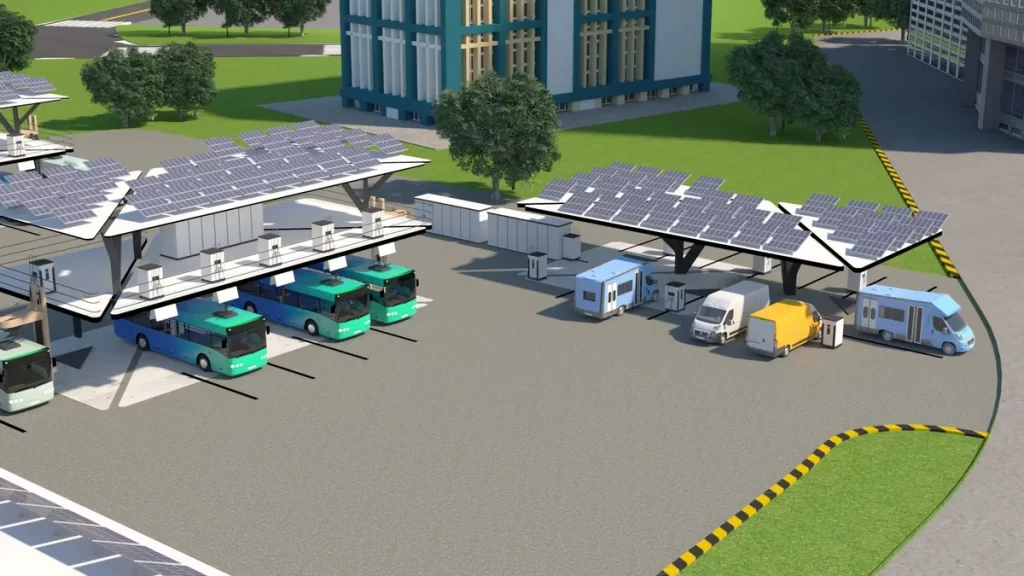
The facility features a 50 kW solar array and 233 kWh battery energy storage system (BESS) working in concert with the charging infrastructure. During the day, solar panels generate power that charges the battery. At night, that stored energy powers vehicle charging, supplemented by grid electricity only as needed.

But it’s more sophisticated than simple solar-plus-storage. The system performs real-time grid arbitrage, buying electricity when rates are low and discharging the battery during expensive peak periods. It shaves demand peaks that would trigger high utility charges. It coordinates solar generation, battery dispatch, building loads, and vehicle charging to minimize total energy costs across the entire facility.

This energy optimization happens as a background process, never interfering with fleet priorities. If vehicles need charging during an expensive rate period, they get charged—but the system draws from the battery first, minimizes grid usage, and staggers loads to avoid demand charges wherever possible.

The result is an 80% reduction in energy costs compared to unmanaged charging. For a depot supporting multiple fleets with dozens of vehicles, that’s many thousands of dollars per month in savings. These savings flow back to Family Laundry’s bottom line.

Built to Scale

The depot’s modular architecture using standardized PortSkids and PortPanels means expansion is straightforward. As Family Laundry adds more vehicles or takes on additional tenant fleets, they can add charging capacity or reconfigure the parking lots’ modular units—no redesign, no custom engineering.

The facility was implemented in two phases: first the charging infrastructure to get operations running, then the solar and storage systems to optimize energy costs. This phased approach allowed the fleet to start benefiting immediately while building toward the complete solution.

A New Model for Fleet Electrification

What makes the Family Laundry depot the world’s most advanced isn’t the hardware—it’s how the system prioritizes fleet operations above everything else. The technology exists to serve the business needs, not the other way around.

Fleets need reliable operations, not science projects. They need vehicles ready on time, every time. They need systems that work invisibly in the background. And increasingly, they need ways to offset infrastructure costs through shared utilization.

Port Power’s approach delivers all of this while also optimizing energy costs and enabling renewable integration. But those benefits come secondary to the primary mission: keeping fleets running smoothly.

As more urban delivery operations electrify, the Family Laundry model offers a template that works: fleet operations first, energy optimization second, and shared infrastructure to improve economics for everyone. That’s the future of managed depots, and it’s already operating in Oakland.


Uncategorized

The 6 EV Charging Facts Every CRE Player Needs…

So you’re a commercial real estate owner or developer and the year is 2023. The Biden administration passed the IRA last year and the IIJA two years ago. States like California and New York are passing legislation to effectively ban non-electric vehicles, gas is over $4 a gallon, and Tesla is the most valuable car manufacturer on the planet. Likely as not, you know that your tenants are going to be replacing their gas-guzzlers with electric vehicles in the coming decade. Someone’s probably already hinted that you better start looking at putting EV chargers in your parking lot and solar panels on your roof.. But why? And how? And when? After all, you don’t have a gas pump there now, do you?

UPS Electric ARRIVAL Vans

Well, electric vehicles are different from gas-powered ones, and electricity is different from gasoline. All that can work in your benefit, or to your detriment. And whether you are in multi-unit housing, retail or logistics, here’s what you need to know as you embark on your journey from CRE player to CRE and Infrastructure player.

The short story is:

  • Your tenants are getting EVs
  • EVs can and should be charged on your property
  • That amenity can make you good money
  • But it requires more than just planting EV chargers and hooking them up
  • To maximize your opportunity and create great service – you will need a “microgrid”, but the government will foot much of the bill
  • And to run it efficiently, you will need a software partner

Now let’s get to the brass tacks.

Your Tenants Are Getting EVs And Need To Charge Them

Whether you own residential units, offices, retail or logistics centers, your tenants are in the process of electrifying their transportation. If they are currently driving passenger cars, they are already eyeing a glitzy Tesla or an economical Chevy Bolt. If they are shipping parcels or dispatching technicians, they may be looking at the Rivian Prime van or the Ford F-150 Lightning. And if they are hauling containers across great distances, someone is already crunching the numbers on a Tesla Semi or Volvo VNR. Lighter vehicles will likely be replaced first, but both market forces and government sticks and carrots (e.g. the Inflation Reduction Act and the Advanced Clean Fleet regulations) are driving this transition for all fleets. Legislation has or is being passed over the country to ban the sales of virtually all fossil fuel vehicles by 2035. But the transition is occurring now, as consumers and fleets realize the practical and climate benefits of this technology, and want to grab the government incentives before they run out. And frankly, so should you!

Your Tenants Will Want To Charge On Your Property

Once they have them, your tenants will need to charge these vehicles. But charging is very different from refueling. Stopping at a gas station, or fueling at a depot only takes a few minutes. Charging a vehicle from empty, whether using Level 2 (“slow”) AC charging or Level 3 DC “Fast Charging”, takes between 30 minutes to hours. For that reason charging at home or a place of work is the best option for most passenger cars, and charging at the depot / terminal / warehouse is the least disruptive option for most delivery vans and trucks. This fact will not change for decades to come. EVs are not smartphones, batteries are not computer chips that double in speed every two years, and vehicles are not replaced with better versions every other year like smartphones.

A microgrid for charging – courtesy of microgridlabs.com

This means that tenants prefer charging where their cars and trucks are parked anyway. And if you can provide them the facilities and the energy there – chargers and electricity, then you are providing a much needed new service, which you can profit off of. In fact, for many tenants in the future this will become a must-have amenity. Delivery fleets will not be able to operate if the vans can’t be charged at night on the premises. Residents will not rent an apartment if they have to park the car a mile from home twice a week to charge it. Truckers will prefer routes where the truck can be charged while it is being unloaded because otherwise they will lose time and money, etc.

Charging will be a must-have amenity. 

Charging Can Make You Good Money

This amenity replaces an existing expense – gas. Consumers and businesses spend trillions of dollars on gas and diesel, and this spending will be replaced by paying for electricity. It’s a service you can and should charge your tenants for, and as will be explained below – can be both highly profitable and relatively predictable. Your goal should be to be able to provide as much of this electricity as will be needed, which will require new infrastructure as described below.

Your goal should be to provide as much of your tenants charging needs as possible

From your tenants’ perspective, time is money. Time spent driving to a public charging station (if one exists) waiting and driving back is an unacceptable price to pay. Therefore they are a captive audience – if you have the charging equipment and power they need, they will pay a premium to charge on the premises. This means that your ability to provide the power effectively – a good customer experience for a consumer or an effective, manageable and time-saving service to a business customer, will make your customers happier and you richer.

To do so effectively and profitably, you will need to be able to provide a lot of power, when and where your tenants need it, and with as little hassle as possible. That requires new electrical infrastructure that goes beyond just sticking on some chargers and hooking them up to the electric panel.

Sticking Chargers In The Ground Is Not Enough

Close but no cigar…

You Need More Electricity At A Lower Cost

Let’s say your tenant has 20 vans to charge at night, and let’s assume you provide level 2 (“slow”) chargers at ~10 kW each. We are looking at about 20 x 10 = 200 kW of power that are needed during those hours with slow charging, and much more if you provide fast charging. For comparison – even this little fleet needs the amount of power required to run 60 homes or a 100 room hotel. If you have many residential tenants with EVs, or commercial tenants with medium to large fleets, you may need a lot more power.

Getting your local utility to commit to install this amount of power and actually deliver it could take years. Add fast chargers, more or larger vehicles, and the conclusion is that it’s not as simple as getting chargers and hooking them up. If you want this to work, you will need to be able to aggregate power, optimize how it’s used, and you will also want to get it cheaply. This introduces new elements to the infrastructure – beyond just chargers. You will probably want to add solar, because almost regardless of where your property is located, solar is the cheapest way to generate electricity – cheaper than buying it from a utility (factoring in the CAPEX, operating costs, and yes – the government incentives).

Solar frees you to some degree from dependence on the utility, and the numbers are quite convincing – especially if you can sell the electricity you generate at a premium, which you absolutely should be able to.

Another element you will most likely benefit from is stationary storage, typically batteries. Storage is useful in a number of ways. First, it lets you take cheap electricity – electricity generated during the day using your solar panels, and electricity bought from the utility during off-peak hours, and use it when you need more of it – whether it’s peak hours (so you avoid paying the higher peak tariffs), or when your tenants are charging most of their vehicles. This allows you to enable them to charge more vehicles at once than the power the utility provides you – because you can add the utility power to the power you extract from your storage. So for instance if your tenants drive all day and charge at night, you can collect cheap solar and off-peak grid power all day, and then use both the electricity in your battery and utility power in parallel to charge many more vehicles at the same time – at night.

Another function of battery storage is improving power quality. For some applications, for instance in manufacturing, even small spikes in power delivery can do a lot of damage. If you have tenants like that, most likely they will require these and benefit greatly from this kind of infrastructure.

And on top of solar and storage, you may want or need to provide back-up generators (gas, diesel), for instance for utility black-outs. This is especially needed if your tenants have fleets that need to continue operation during emergencies – e.g. technicians, first responders etc.

These energy resources that you control to generate or store electricity are offered referred to as Distributed Energy Resources (DER) that are installed “behind-the-meter”. Another term typically used is a “micro-grid”. It’s a grid that can operate independently of the utility grid.

Be The Master of Your Microgrid

When you have a microgrid, you can optimize your energy assets for your tenants’ use. For instance, you can prioritize resilience, by trying to keep your storage battery as full as you can so there is always power in case of an outage. In that case you charge it fully whenever possible. Alternatively you can optimize for costs, trying to only buy electricity from the grid when it’s cheap (e.g. in the morning), and when you have more than you need and the tariff is high – sell it back to the utility for a profit. Or you can try to strike a balance between these approaches, or even have a different policy every day depending on your tenant’s fleets behaviors, the season etc.

A microgrid controller is a computer system that monitors all of the elements in your microgrid and controls their actions. A microgrid management system, the software that manages the controller, allows you to monitor and control your system, implement policies, track equipment usage over time, create reports for analysis, financial reporting and billing and more. It’s the brain that ties your energy system together, allows you to understand what’s happening and respond / plan effectively. Most microgrid controllers will also allow you to control equipment from different vendors. For instance you may buy chargers from one company, storage from another and a generator from a third. A controller that can manage all of them is critical for interoperability. Planning, optimizing and controlling your energy resources is a critical part of giving your tenants good service – and optimizing the profit from these new assets.

Managing Your Charging Assets Requires Advanced Software

OK, so you got the power assets, and you got the chargers. Your tenants have vehicles, but they also have their particular needs and schedules. These may be relatively simple if it’s just consumers (e.g. residential tenants, office-building workers) or quite complex if they are managed fleets like delivery or transportation fleets. They will have particular times they want to charge at and have the vehicles ready at, they may need to be able to prioritize particular vehicles according to their missions or who’s driving them, and so forth. Again – charging takes time, and therefore you can’t necessarily simply adopt a “first-come-first-serve” policy.

If your tenants are simply residential or office workers, you are losing money and goodwill  if some of them are denied and need to drive somewhere else to look for public charging because they need a full battery tomorrow morning. You may want to have different priorities and pricing, e.g. monthly chargers get priority access and bulk pricing. You may want to restrict charging by guests, or enable reception to allow it. You may want to charge the tenant who’s hosting the guest (like “validating parking”) and so on and so forth. There will be different requirements, and you will want to be able to easily identify the vehicles, associate them with the tenants, and apply your policies – all based on your available energy and charging resources.

If your tenants are commercial and their fleet activities are critical and scheduled, there will be more integration required, such that vehicles that need to be ready at particular times can get priority at these times – reserving a charger, reserving energy and so on. These services carry a premium, and they require integrating tenant systems data (e.g. from their fleet management system) with your charging system control. This article can provide you more perspective on what fleet managers need from their charging infrastructure.

These needs mean that to optimize the value from your energy assets, you will need a software system that has the ability to accommodate these different charging schemes, pricing and billing schemes, tenants’ fleet information system and your facility management systems. Such a system works best if it is directly integrated with all of your energy assets – your chargers as well as your microgrid assets. Integrating systems from separate providers can be a losing battle. The system you use should be able to manage your physical hardware that was probably sourced from different vendors, and create interoperability between different vendors’ equipment. That is a critical requirement in the long term, as you may want to expand, upgrade and replace components over the decades that these assets are useful for. Being tied to a specific vendor could become very restrictive over time.

Electrification – It’s Your Long Term Growth Play

Electrification is the name of the game for the decades to come. The combination of climate-change regulation with the improvement in the quality and cost of the assets – from vehicles to solar panels, means these assets are a great add-on to your real-estate portfolio. But to optimize utilization and profit you need to have a whole system built, operated and maintained. That system should serve your tenants’ evolving needs, and grow with them as they go through the process of transitioning their vehicles to electric over the coming decade. Having a strong partner by your side, that is able to assist in planning, operating and expanding your systems while optimizing the financial and energy yield is paramount to getting your dollar’s worth. You can choose to be a leader and corner the market, or you can choose to be a laggard. More about why it makes sense to get in early in a subsequent article.